

Contact

Company News, Industry News, SEO Strategy Articles

We Elevated Our Skills with the Best SEMrush Training Available

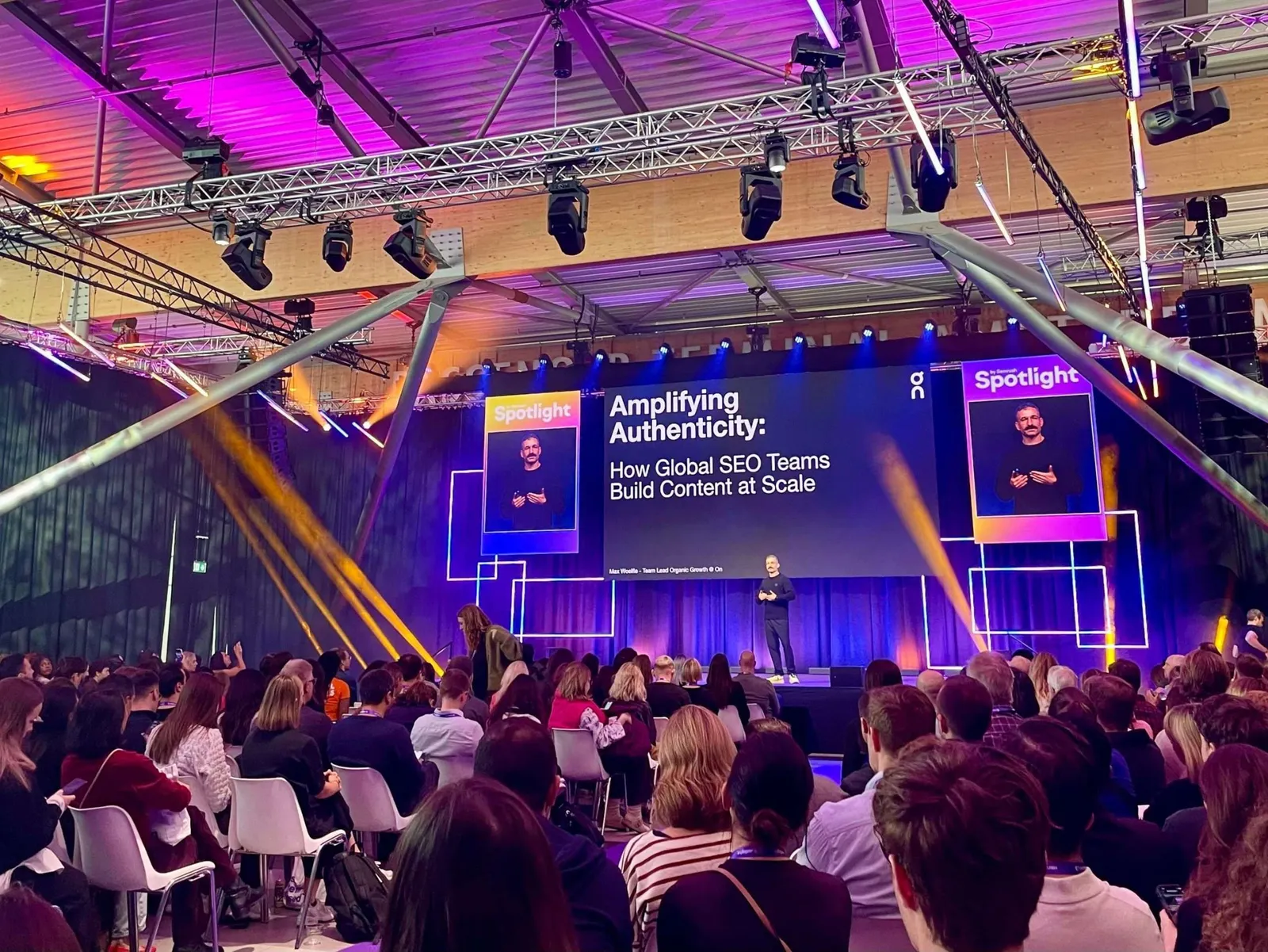
SEMrush speaker with screen that reads “Amplifying Authenticity: How Global SEO Teams Build Content at Scale”
At the end of October we traded the Bristol drizzle for Amsterdam’s canals to attend Semrush Spotlight, a two-day deep dive into what SEO and brand visibility look like in…

In this article:

Semrush Spotlight Amsterdam conference signage welcoming SEO and AEO delegates to the two-day event

At the end of October we traded the Bristol drizzle for Amsterdam’s canals to attend Semrush Spotlight, a two-day deep dive into what SEO and brand visibility look like in an AI-first world.

The first day started with housekeeping, Wi-Fi passwords and one important ask:

Opening keynote slide asking delegates to bring laptops and live dashboards to every Semrush Spotlight session

This wasn’t going to be a passive conference. Laptops were open, dashboards were live and we were expected to put every framework straight into our own data as we went.

SEMrush Training: Where AI Really Gets Its Answers

Semrush speaker presenting where AI tools source brand information across reviews, forums and help centres

One of the first sessions asked a deceptively simple question: when someone asks an AI tool about your brand, where does it look?

The answer stretches way beyond your website:

  • Review platforms and comparison sites
  • Developer forums and support communities
  • Support docs and help centres
  • Reddit threads and other social spaces (especially around pricing and complaints)
  • News sites and PR coverage
  • Your own pricing pages, FAQs and product content

If your marketing strategy stops at “blog + landing pages”, you’re invisible to a huge chunk of the signals AI systems pull from. Mapping search intent across all these surfaces is now table stakes.

Reddit, Communities and the New Default

On the second day, we transitioned to the larger conference hall and immediately dove deeper into advanced AI-driven SEO and AEO strategies.

Bar chart showing Reddit visitor growth overtaking Wikipedia to become a top global site by 2026

A striking graph showed Reddit’s growth versus Wikipedia, with Reddit now effectively the second-largest site on the web in this data set. It’s where people go to ask unfiltered questions, and AI systems reflect that behaviour.

Screen showcasing that 30% of clicks in searches with AI Overviews go to community and video platforms

Another chart compared outbound clicks on SERPs with and without AI Overviews. When AI summaries appear, a noticeable portion of clicks shift towards community and video platforms. Google’s direction here is set out in its own AI search announcement.

For brands, that means treating Reddit, YouTube, TikTok and niche forums as core parts of your search strategy, not side quests.

Playing the Sentiment Game

Conference slide titled How to get seen: The Sentiment Game introducing brand sentiment for AI visibility

The first big theme of the first day was sentiment, how AI systems interpret the tone of conversation around your brand.

AI doesn’t just ask “Who are you?” – it asks “What does everyone else think about you?”

Semrush’s practical tips for improving that picture:

  • Be present on the right review sites. AI leans heavily on reviews, but not all platforms matter equally.
  • Join community conversations. Reddit, Quora and specialist forums consistently show up as sources in AI answers.
  • Engineer social proof. Case studies, testimonials, UGC and “we tried X so you don’t have to” content all become training data.
Slide collage of listicles, third-party reviews and tool round-ups frequently cited inside AI answers

We saw example SERPs where listicles like “The 10 Best X Tools for Y” dominated results and got cited inside AI responses. If you’re not in those articles, you’re excluded from an entire layer of visibility.

The Authority Game: Being the Site AI Trusts

Conference slide titled How to be trusted: The Authority Game explaining citation worthiness for LLMs

The second theme was authority, how confident AI systems feel citing your content. This is closely linked to topical authority.

You can’t fake authority. You have to:

  • Make your site technically accessible. Clean HTML, structured data and readable code so AI can actually parse what you’ve written.
  • Fix public data. Wikipedia entries, knowledge-graph data and public profiles shape every AI summary about you. Incorrect there = incorrect everywhere.
  • Be transparent. Hidden pricing and vague FAQs push users to Reddit and LinkedIn for answers, and that speculation is exactly what AI tools will learn from.

The Five Stages of an AI-Ready Content Strategy

Colourful wheel diagram mapping Stage 1 Research through to Stage 5 Visibility for AI-ready content

Another session introduced a five-stage model for building an AI-ready content ecosystem:

  1. Research – Listen to how customers actually talk: calls, live chats, survey responses, Reddit threads.
  2. Architecture – Design navigation that mirrors those mental models instead of internal team structures.
  3. Content – Enable all teams (marketing, product, support, sales) to contribute content within that architecture.
  4. Alignment – Let that structure become the source of truth inside the organisation.
  5. Visibility – Reap the rewards as AI systems start to favour your depth, clarity and authority.
Semrush speaker walking delegates through the five-stage content strategy framework on stage

Writing for LLM Visibility (Not Just Blue Links)

Conference slide titled Writing for LLM Visibility outlining seven rules for content that LLMs quote

We then got a very tactical session on how to write content that LLMs want to quote. Key rules:

  • Lead with the answer. Start each section with a sentence that directly answers the implied question. Expand afterwards.
  • Mirror the heading. If the heading is “How do I…”, start with “To… you should…”. This makes it easier for models to match sections to prompts.
  • Keep it human and concise. Short sentences, plain language, tight paragraphs.
  • Make it quotable. Include unique stats, expert opinions or proprietary insights that are worth pulling into an AI summary.
  • Strengthen entity signals. Use explicit names for products, brands and people, not just “we/they/it”.
  • Use question-based headings. They map directly to what users type into AI tools, mirroring People Also Ask.
  • Cluster prompts. Group related questions on the same page to show topical depth.

Semrush has turned this into an internal guide built on two core principles:

  • Freshnesscontent is regularly updated, not abandoned.
  • Consistency – terminology, structure and patterns stay predictable across the site.

SEO vs AEO: 90% Overlap, 10% New Rules

Venn diagram slide titled 90% overlap, but not 100% comparing SEO and AEO ranking factors

A Venn diagram compared SEO with AEO (Answer Engine Optimisation):

  • SEO focuses on things like crawling, SERP features, keywords, E-E-A-T, clicks and user signals.
  • AEO focuses on semantic HTML, mentions (not just links), long prompts, personalisation, influence and consensus.
  • The overlap: technical accessibility, content quality and authority signals.

If you’ve already built strong SEO foundations, you’re most of the way there, but that final 10% requires thinking about prompts, mentions and how AI actually “reasons” about your content.

Reporting in an AI-First World

Slide titled Best practices for scaling reporting beside an example traffic dashboard with trend lines

With AI reshaping how users search, reporting needs a refresh too. Good SEO KPI reports should be:

  • Actionable – every chart implies a decision.
  • Easy to understand – minimal clutter, clear legends.
  • Insight-led – emphasise context and causality, not just numbers.
  • Results-oriented – focused on leads, revenue or key outcomes.
  • Contextual – showing trend lines, not isolated snapshots.
Provocative conference slide reading Turns out, impressions are a lie above flat conversion charts

One memorable slide showed multiple examples where impressions were soaring while meaningful outcomes stagnated. In an AI world, impressions can lie. What matters is:

  • Are you appearing in AI summaries?
  • Does that presence drive conversions, not just visits?

Content at Scale: Building a “Content Factory”

SEMrush speaker with screen reading Amplifying Authenticity: How Global SEO Teams Build Content at Scale
Diagram of a content production factory line covering research, briefing, creation, localisation and analysis

One of the most useful sessions for our agency brain was about operationalising content at scale. The process looked like a factory line:

  1. Topic research – often with agency involvement to map opportunity.
  2. Briefing & editorial review – clear expectations and a trusted editor.
  3. Creation – in-house writers and/or external partners.
  4. Translation & localisation – with transcreation for key markets.
  5. Asset sourcing & upload – visuals, structured data, internal links.
  6. Impact analysis & maintenance – updating, pruning and expanding winning content.

Scale doesn’t come from shouting “we need more content”. It comes from process.

The AI SEO Revolution, in Charts

Speaker with screen reading Biggest technology revolution since Google founded in 1998 referring to AI

The afternoon keynotes zoomed out to look at macro trends. One speaker framed the current shift as:

“The biggest technology revolution since Google launched in 1998.”

And then proceeded to back that up with data.

Traditional Search vs AI Tools

Long bar chart comparing Traditional Search vs AI Tool Visits in the USA from 2023 through 2025

A long bar chart showed desktop visits over time:

  • Traditional search still dominates, but
  • Visits to AI tools are steadily climbing, month after month.

We’re in a both-and world for now, but the direction of travel is clear.

The Real Maths of AI SEO

Slide titled The real maths of AI SEO summarising brand citation and conversion uplift statistics

We saw stats highlighting that:

  • Only a minority of brands that show up in AI answers are also cited as sources.
  • A big chunk of Google’s results now appear inside AI answers rather than as separate links.
  • Visitors who arrive from AI surfaces often show significantly higher conversion rates than standard SERP traffic.

So while “traffic is down” is a common story, value per visit from AI search can be much higher.

AI Overviews and Click Squeeze

Chart showing organic clicks drop by 50% when users encounter Google searches that include AI summaries
Conference slide reading AI Overviews are everywhere with rising query share trend lines across categories

Data from US search showed:

  • When AI Overviews appear, users are less likely to click a traditional organic result.
  • The share of queries triggering those overviews has been rising fast.

That’s the context behind many SEO dashboards right now: more impressions, fewer clicks, different behaviour. Google’s own Search Console help documents how the data is collected.

Who Gets Quoted by LLMs?

Slide listing Top Domains Cited on LLMs across ChatGPT, Perplexity, AI Mode and AI Overviews

One eye-opening slide ranked the top domains being cited by major LLMs and AI surfaces. Alongside expected names like Wikipedia, there were:

  • Big review and marketplace sites
  • Specialist content brands
  • Major communities and forums

For BrisTechTonic, this reinforced that digital PR and partnership strategies should deliberately target domains that LLMs already love citing.

Overlap with Google Rankings

Graph comparing domain and URL citation overlap between Google AI Mode, AI Overviews, ChatGPT and Perplexity

Another graph compared domain and URL overlap between:

  • Google AI Mode
  • Google AI Overviews
  • ChatGPT citations
  • Perplexity citations
  • Classic Google top-10 results

The overlap was high, especially at the domain level, but not perfect. Good SEO gives you a head start, but AI introduces new ways to win (or lose) visibility.

From Theory to Playbook: The 4P Framework

Slide titled 4P Framework: Presence, Priority, Prompts, Perception as the AEO action plan

To make sense of all this, we were given the 4P Framework, a practical way to decide where to focus:

  1. Presence (Citation Gap)
    • What content drives visibility? Where are competitors cited and you’re not?
    • Tool: AI Toolkit – competitor research and sources reports.
  2. Priority (Platform Priority)
    • Where do you actually need to show up?
    • Tool: Keyword and platform research – which domains, communities and formats dominate your niche?
  3. Prompts (Reasoning Crawls)
    • Do you monitor the right prompts?
    • Tool: Log file analysis – what are AI agents crawling, and which queries does that imply?
  4. Perception (Web Footprint)
    • Are you perceived as an authority?
    • Tool: Brand monitoring – mentions, sentiment and share of voice.

Prioritising the 4Ps

Slide titled 4P prioritisation framework showing a two-by-two chart of effort versus impact

A prioritisation matrix helped rank where to start:

  • Platform Prioritisationhigh impact, relatively low effort: choose the communities and platforms that move the needle first.
  • Citation Gaphigh impact, higher effort: content and partnership work to get cited where competitors already are.
  • Web Footprint – foundational work: overall brand presence and authority.
  • Reasoning Crawls – more advanced: high-effort monitoring for marginal gains once the basics are in place.

Deep Dive: Citation Gaps & Reasoning Crawls

Slide titled Citation gap table comparing where competitors are cited across major LLM surfaces
Worked example of a citation-gap report in the Semrush AI Toolkit competitor research module

Citation gap analysis in practice:

  1. In the AI Toolkit, open Competitor Research → Sources.
  2. Start with the “missing” filter, that’s where competitors are cited but you aren’t.
  3. Filter for sources where at least two competitors are cited.
  4. Run this separately for each major LLM / AI surface.
  5. Compare the cited content against your own – where are you weak or absent?
  6. Plan content, PR and partnerships to fill those gaps.
Server log dashboard isolating AI user-agents and tracking reasoning-crawl growth per URL over time

Reasoning crawls are when AI agents explore your site to answer future user questions. To monitor them:

  • Filter server logs / Cloudflare by AI user-agent.
  • Track crawl growth over time.
  • Identify which pages get the most reasoning crawls.
  • Build or refine prompts around those pages.
  • Redirect 404s that still receive reasoning crawls, don’t waste that attention.

This is advanced, but it’s where larger brands will gain an edge.

What This All Means for BrisTechTonic Clients

Semrush Spotlight Amsterdam was dense, but a few clear themes emerge for how we work with clients:

  1. AI visibility is an outcome, not a hack.
    It reflects your architecture, content quality, community presence and internal alignment.
  2. Classic SEO still matters, a lot.
    Strong technical SEO and quality content underpin both search results and AI answers.
  3. Communities, reviews and ecosystems are now core search channels.
    Reddit, forums, marketplaces and creator ecosystems will be baked into any serious visibility strategy.
  4. We need new KPIs.
    We’ll be looking beyond impressions to track citations, LLM sentiment, AI-driven conversions and share of voice. For more insights on The Future of SEO, AI and how reporting is changing, see how organisations are adapting to these shifts.
  5. There’s a playbook for what to do next.
    The 4P Framework, citation gap analyses and reasoning-crawl monitoring give us practical, prioritised steps.

For us, the real excitement is in turning these ideas into concrete experiments and frameworks for our clients, from LLM-optimised content and smarter reporting to strategies that help users discover, trust and choose your brand in an AI-shaped search landscape.

Related posts